
Tradition meets Technology: Drone use in the world of Missing and Murdered Indigenous Persons


This past February, I had the incredible honor of being invited to the Fourth Annual Missing
and Murdered Indigenous Persons Tribal Policy Summit. This event was lead by the Yurok Tribe, the largest federally recognized Tribe in California. The conference took place in Wheatland, a relatively short drive from my own home.

I was invited by my friend Alanna Wright, a member of the Yurok Tribe as well as a Search and Rescue Drone Pilot. We’d connected thanks to Nova last year, and have spent that time trying to find any sort of opening in our busy schedules to get together and both train on Drone SAR tactics as well as discuss the Missing and Murdered Indigenous Persons, or MMIP, phenomena. So when, after our latest attempt to find time to hang out, she informed me that there was not only a MMIP conference happening in my area soon but that she would be a speaker at it detailing her mission to use Drones and ROV’s to help… I couldn’t sign up fast enough.
Now I use the word phenomena not to try and evoke a mystical sense of the MMIP crisis. The Oxford Learner’s Dictionary lists the definition of phenomena as “a fact or an event in nature or society, especially one that is not fully understood.” Which I think truly sums up precisely what is happening.
In 2023 Homicide was the 4th leading killer of Indigenous Males ages 1-44, and the 6th leading killer of Indigenous Females ages 1-44. In this same year, homicide accounted for 1.5% of total American Indian and Alaska Native deaths, and 0.2% for the White population. In 2020, 10% of all active missing person cases in the U.S. were for Native Americans. The latest census puts the native population at just around 1.3% of our nation’s total.
This isn’t politics. This is raw data.
So to go back to the dictionary definition of phenomena, it is a FACT that something is happening, and it is DEFINITELY not fully understood. And after the conference, after hearing so many of the stories of loss and frustration and agony, I am left just as confused as well.
So many of the stories of MMIP shared the same common thread. A loved one is shot, stabbed, drops dead under suspicious circumstances, or vanishes into thin air. The distraught family seeks answers, and are given none. The friends ask for help, and none comes.
I hate mysteries. Always have. I’m the sort of person who will spoil a book series, tv show, or movie for himself by reading the wiki because I can’t stand not knowing what happens. So as I listened to the speakers share their stories of stonewalled investigations, slow walked reports, and years without any sort of closure or leads, I found myself grinding my teeth in frustration. Finding the missing and recovering the lost is one of the whole reasons I started North Wind Aerial. It’s why I’ve dedicated the last decade of my life to volunteer service in Firefighting, EMS, and SAR. Helping others, regardless of their race and social status. Not doing everything possible to help out another human is anathema to my very being. How could this happen? How could this keep happening?
These feelings and values are obviously not universal, otherwise we wouldn’t have this ongoing crisis. I feel like Geraldine McGarva of the Pit River Tribe sums up how many of her kin feel: “There’s no County in the United States that gives a shit about what happens to an
Indian.”

Geraldine’s brother Milton “Yogi” McGarva was murdered on March 9th, 2020, stabbed to death in his own home by Jarrett Bleu Rucker. I would say allegedly, but Rucker confessed to the murder. 40 times in fact. And without the collaborative efforts between Geraldine and Morning Star Gali from Indigenous Justice, there’s a good chance Rucker would have walked free. It took over nearly 4 years to get justice, but on February 27th, 2024, a jury found Rucker guilty of first degree murder and sentenced him to 26 years to life in prison.

One win in a sea of unsolved and uninvestigated cases. Bernadette and Natalie Smith shared the story of their sister, Nicole Smith. Nicole was a mother of 3, shot to death in Bernadette’s home in 2017. Not only has her case gone unsolved for this long, a mural honoring her life was vandalized in November of 2025. Blatant disrespect piled on top of a senseless tragedy.
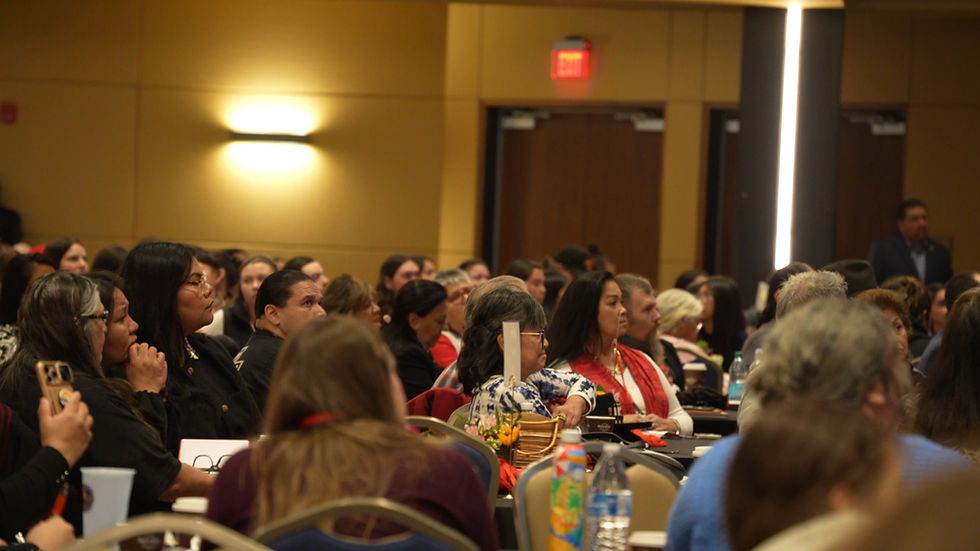
I spent the entire day taking in these stories and talking to members of the crowd. I knew about the MMIP epidemic, but this was my first time truly taking it in. Being surrounded by the families enduring the pain and standing resilient together in spite of it. It brought it all home in ways only complete immersion can.
But thankfully there are always people trying to help. The conference room that held around a thousand people had dozens of booths with information, programs, and contacts. Everyone I spoke to was humble yet driven. You could see it in the embers burning behind their eyes, in their pursed smiles, in their joy at networking. Everyone in attendance knew the gravity of the situation and the seriousness of the presentations, and was working towards making it better.
Few more so than my friend Alanna, a fellow drone pilot from the far North Western corner of California, who gave a speech on her efforts to use technology to locate those lost.
“I’ll talk a little about my capabilities. I’m one person, I’d like to point that out. I’m one person. But I want this room to know that even one person with a little bit of support from their tribe, from their community, and with monetary support can make a huge difference, a huge impact, at actually answering the call at 2 in the morning when your loved one is missing.” says Alanna.

She goes on to describe the UAS and ROV equipment she utilizes in her mission. Ground penetrating radar, thermal imaging, underwater searching in the rivers of her region. An incredible blending of cutting edge technology and traditional values.
Writing this now I’m reminded of a conversation her and I had about how she carries a bag of tobacco with her on SAR calls that she leaves pinches for as tribute and offering to the spirits of her land. An ancient rite conducted while carrying a portable tiny helicopter in a Pelican case.
I’ve since started carrying a bag of tobacco in my SAR backpack as well.
Alanna shares some of the calls she’s been on. She assures the room that she will come any time, any day to help find their loved ones. “If it is physically possible for me to come, I will come.” she says. “I’m trying my best. And I can sleep at night knowing that I’ve given my best.”
This drive and attitude is what personally keeps me doing Search And Rescue, even when I want to throw my badge on the floor out of frustration. That drive to give people answers to their loved ones' disappearance, to hopefully find them alive or recover their remains if I am physically able to respond. To be able to lay down at night knowing I did everything I possibly could for my community.
These are brave words to type on a personal blog I understand, but it’s something we should all keep in mind. One of my greatest frustrations with the Search And Rescue system is how bureaucracy and ego gets in the way of getting things done. The ability to “try our best” is so often hampered by small details, red tape, or the inability to work together. Problems that are incredibly prevalent especially in the world of Indigenous peoples. I encourage all SAR members to continuously advocate for our community, no matter their background, when someone goes missing. Never write it off, never let it get buried, and never be too proud to ask for help from outside agencies on a search. At the end of the day, we truly are all the same species and we need to act like it.

Once Alanna finished her speech, we snapped a quick photo together, laughing about how we’d finally gotten to semi hang out over well over a year of chatting back and forth. We both had long drives to get back home with plenty of responsibilities waiting for us. I packed up my camera gear and walked past all of the faces of the missing pinned up around the room one final time. Sobering reminders of justice left undone and the worst questions imaginable left unanswered. Every murder a case that deserves a full investigation, every portrait a missing person that should have had a full SAR team mission launched for them. I resolved to live by Alanna’s words when it came to assisting with MMIP cases in my area. I resolved to try my best.
The words that have stuck in my mind more than any others since the summit however, is the quote from Geraldine. “There’s no County in the United States that gives a shit about what happens to an Indian.” There is not a single person, no matter their background, skin color, gender, or social status, that should EVER feel this way. Everyone deserves, at the bare minimum, to know that the people in charge of finding their lost loved ones and bringing their families' killers to justice care about them and their case.
So I may be but one guy with the power to do very little outside of trying to raise awareness and help search for the lost when I can, but I can promise you Geraldine, I give a shit.


Comments